
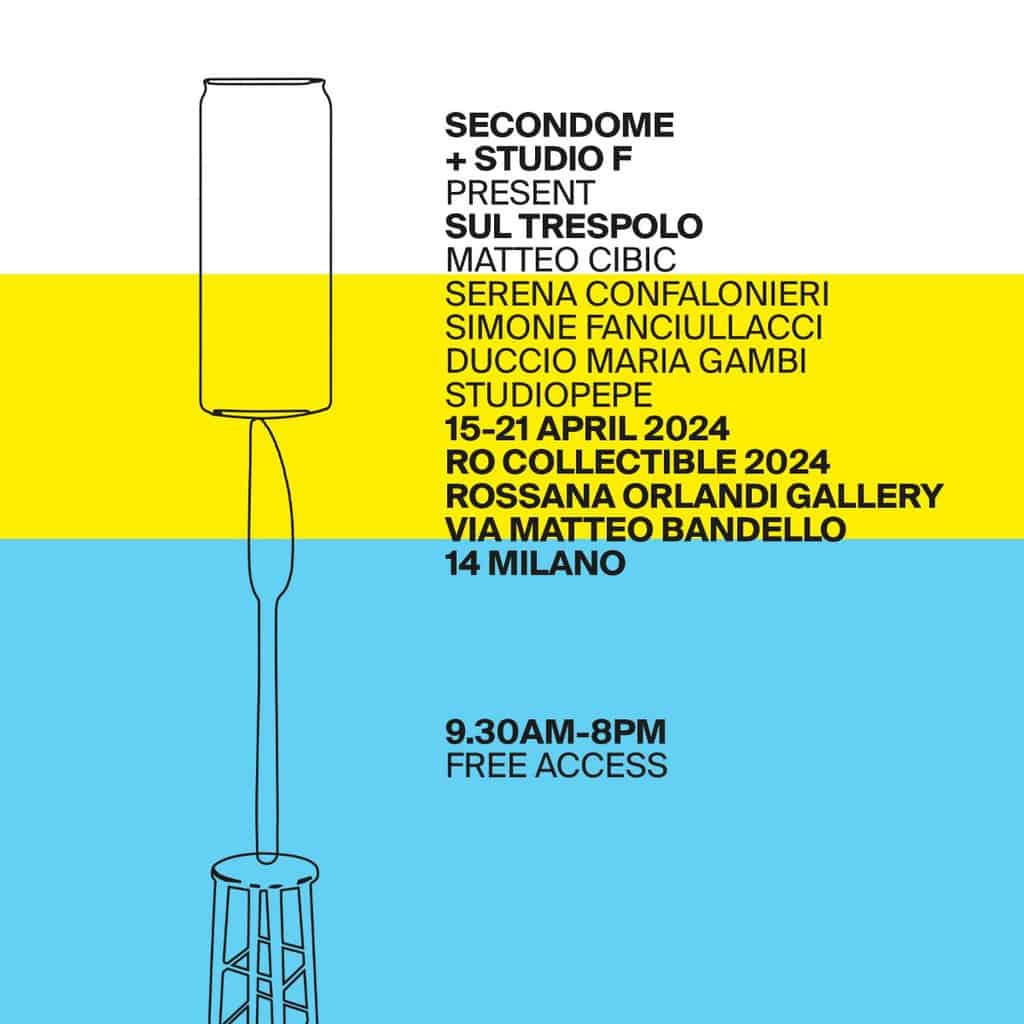
Sul Trespolo
(On the Trestle)
“If I say ‘On the Trestle’, what comes to Your mind?”
It’s from this question that the second adventure of Secondome + Studio F begins.
Curated by Claudia Pignatale, it features five design studios: Matteo Cibic, Serena Confalonieri, Simone Fanciullacci, Duccio Maria Gambi, Studiopepe.
In literature, the term Trestle (Trespolo), which derives from the Latin ‘tripes -pĕdis’ meaning “three feet,” is used metaphorically to symbolize the base or foundation of something.
The term evokes an image of a wooden object , or more precisely, the most supreme of all wooden Objects (with a capital O), followed only by the table, which, for production purposes, requires both wood and a trestle.
The result is a heterogeneous collection of unconventional furnishing accessories, dreamed and dreamy objects.
Secondome and Studio F are two Italian realities that share a passion for design, craftsmanship, and Made in Italy. The woods used are strictly Italian reclaimed woods, such as National Walnut, Canaletto Walnut, Cherry, Maple, Ash, Oak, and Cedar, accompanied by precious materials from Italian tradition, such as Murano glass blown from sheet and copper.
Olga by Matteo Cibic
“Olga has 3 legs and a cloak of boiling lava.”
Olga, the table by Matteo Cibic with a solid oak wood base.
Like lava flowing placidly along its path, with the millennia-old solidity of rock written in its destiny, this three-legged work has taken shape: sinuous and robust, balanced and strong. The combination of natural materials and fantastical elements gives this piece an appealing appearance, an imagery of mutation: an inevitable as well as desirable transition from one state to another.
Birdie by Serena Confalonieri
An extraordinary piece of furniture inspired by the concrete and poetic concept of a pedestal. A vertical structure of which the pedestal constitutes a small component of the entire object.
Drawing inspiration from the type of skyscraper furniture born around the 1960s, Birdie is configured as a sequence of different and well-defined functional elements that, placed side by side and stacked, form an irregular column of geometric shapes. The result visually evokes the image of a block construction in which the individual modules retain a distinct identity, also thanks to the use of different wood essences such as maple, cherry, and Canaletto walnut.
Consisting of blocks with different functions — a storage element, a support surface, a mirror, the pedestal designed to support and hang objects, and, finally, two other storage elements. Just as in block constructions, Birdie can be disassembled and divided into 3 interchangeable modules thanks to a threaded central support and cubes that serve as stops, allowing for the transformation and customization of the furniture to adapt it to individual habits and preferences.
Claude by Duccio Maria Gambi
Summer, sun, joy, slow life.
Colors blend, bright transparencies and brilliant opacities, sharp shadows that interrupt and seal entities outside and around. Everything melts and merges into a suspended memory that finds its necessity in contrast with what surrounds it and, solidly, supports it.
Can one smell all this on a pedestal?
It is in this light imagery that “Claude” was born: a collection of shelves and consoles in Murano glass with fluid and luminous shapes, supported by massive and geometric blocks of reclaimed Canaletto walnut. The title is an homage to the photographer Claude Nori, that has taken many pictures of Italy in summertime in 1982.
The Murano glass fused from sheet recalls the texture, brilliance, and transparency of melting icicles. The wooden blocks are made of Canaletto walnut reclaimed from a small forest of twenty-one walnut trees on the banks of the Seveso river, which required deforestation due to the construction of more containing embankments.
Epoca by Simone Fanciullacci
A throne obtained by juxtaposing two elements entirely in walnut wood, as if they were relics from an arcane structure. The result is itself an enigmatic, asymmetrical object that appears different from every point of view and forces the eye to move between solids and voids to embrace the whole. The seat is anti-ergonomic, not a chair to feel comfortable in, but to force the body into the object, eliciting unexpected sensations.
Alter Ego by Studiopepe, a multidisciplinary studio formed by Arianna Lelli Mami and Chiara Di Pinto. The Latin phrase alter ego indicates ‘another self,’ a second personality within the same person, with characteristics distinctly different from the first. “We are interested in the theme of identity, which here we wanted to suggest as a search for inner identity, the Self.”
The Ego manages environmental stimuli and studies consequential responses. It gives us a structure, but at the same time it cages us, it gives us a view of reality mediated by the filters through which we see the world.
The Other Ego, on the other hand, is the Self. The Self, from an introspective point of view, is considered the core of the person, which must be distinguished from the ego, that is its reflected image in which consciousness normally identifies itself. It generally represents the superior principle of the individual, which according to an esoteric interpretation would bear inscribed the destiny and guidelines of its conduct. While the Self delineates the person in its entirety with respect to the environment, the ego, inscribed in the Self, is the structure that perceives itself and enters into relation with other people. The cage/structure is the Ego. The light is that of consciousness that helps us see our essence, the Self, represented by the mirrored lacquered circle. The wood finishes are those often found inside Buddhist monasteries, cedar wood symbolizing longevity and strength and resistance and has been used for ceremonial purposes since antiquity. It is mirettato, according to the Japanese technique Naguri, while the tray is made of polished mirror copper.
Sul Trespolo | Secondome + Studio F
April 15-23, 2024 at Galleria Rossana Orlandi | via Matteo Bandello 14
Pictograms by Davide D’Elia
special thanks to: Besana Carpet Lab
Credits: Serena Eller / Eller Studio
[ngg src=”galleries” ids=”25″ display=”basic_thumbnail” thumbnail_crop=”0″]