
EFFIMERA
A project by Giorgio Galotti – Claudia Pignatale
In collaboration with MAXXI – Museo nazionale delle arti del XXI secolo
In partnership with Moroso
“Everything is ephemeral, both what remembers, and what is remembered.”
Marco Aurelius
Effimera stands as an homage to the beauty of the temporary, the intangible, the transient.
The exhibition project conceived for the 2024 Internazionali BNL d’Italia continues the reflection initiated in the previous edition on the role of Rome in the world. The exhibited works reflect the transience of beauty and the temporality of human existence, challenging the perception of our ever-evolving world. Experience the beauty that blooms only for a moment, leaving an indelible imprint in our memory.
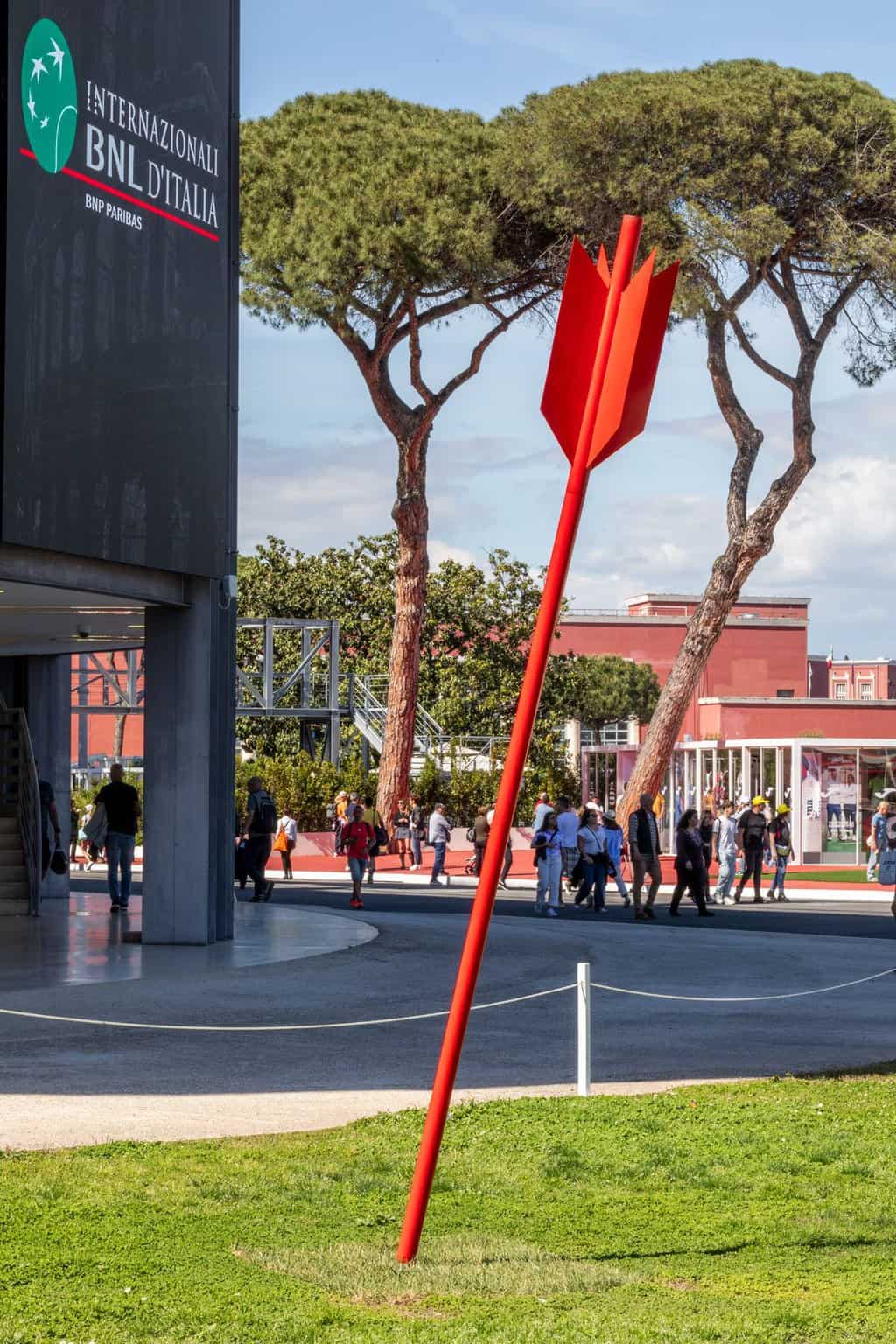
The exhibition aims to give visitors some visual suggestions, starting from the external areas of the Foro Italico, with Felice Levini‘s six arrows, kindly provided by Hypermaremma for the occasion. These arrows symbolically represent the activity of some Roman deities, who hurl fiery red darts from the sky onto the ground to represent their involvement in the daily feats of the competing athletes, merging mythology, religion, and symbolism in a metaphysical scenario where the role of the arrow is marked as a vector, indication, sudden movement.
Moving on to LEA, in Luigi Moretti’s Sala delle Armi, on one side there’s the environmental installation by the collective Objects of Common Interest, on loan from the MAXXI – National Museum of 21st Century Arts, and on the other side, a site-specific wall installation by Giuseppe Pietroniro. Objects of Common Interest’s Tube Column is a luminous installation with abstract sculptural articulations illuminated from within, emerging from the floor of the room. The work consists of curved segments connected to each other and placed on a mirror-polished stainless steel plate that extends the forms beyond the ground to stimulate in the observer a transition of terrestrial matter.
The lounge area is characterized by Patricia Urquiola‘s Pacific sofas and armchairs for Moroso, evoking the relaxed atmospheres of the American West Coast from which they take their name, paired with across big tables by secondome in collaboration with Siderio. On the terrace in the bar area, there are Riviera tables and chairs by Lucidi Pevere, and the Ivi collection lounges by Paola Navone for Emu.
Continuing towards the central tennis stadium, on the bridge leading players to the stadium, there’s the installation “The future is here, somewhere” by Numero Cromatico, a 20-meter luminous inscription. The work doesn’t aim to convey a specific message or indicate a direction but offers the audience the opportunity to critically and potentially interrogate the present. The text is part of a poetic anthology by Numero Cromatico, created with the help of S.O.N.H. (Statements Of a New Humanity), the collective’s artificial intelligence specifically trained in producing statements about the future of humanity.
The FIC lounge hosts a site-specific mural intervention and some paintings by Giulia Mangoni (Isola del Liri, 1991). Her research oscillates between intimacy and the extrapolation of cults of popular origin internalized by the artist and rendered to the public in new compositions that transition from mythology to the contemporary era.
Giovanni Botticelli‘s Vetrografica mirrors are added to the room. The glass surface becomes a canvas on which to paint graphic motifs that break the reflection, making it itself part of the mural. In the room, there are Gogan sofas, named after Japanese river stones smoothed by wind and water, and Redondo with its geometry devoid of edges by Patricia Urquiola for Moroso, Marbelicious tables by Millim Studio, irregular marble forms that enter into dialogue with pure matter, contributing to create a play of lights, shadows, and textures. A series of interconnected elements that evolve as a single entity. Marble thus acquires fluidity and movement. Ottoman armchairs by Sholten & Beijings, inspired by the Ottoman Empire and revisited in a contemporary key with fluorescent colors, colors also found in the Anomaly poufs by Front Design, creatures with a delicately unsettling identity, docile and innocent.
The Montemario Sud lounge hosts the research of Jimmy MIlani (Savigliano, 1995).
Black circles become iconic subjects that interact with each other, giving life to an environmental installation that translates the two-dimensional intent into a three-dimensional version that scrutinizes the visitor and activates an unexpected interaction between artwork and observer.
In contrast, there is Patricia Urquiola‘s Gogan sofa in an abyss green fabric, the colorful Square armchairs by Jonathan Olivares characterized by pure geometric shapes, and the Dada table by Marco Pettinari, a plexiglass sculpture with bright colors and irregular shape.
Giuseppe De Mattia (Bari, 1980) presents a series of works titled Ex votos, arranged on a wall of the North Montemario Hall to relate to a detached sculptural work titled Gazza. Following its instinct, the magpie steals and accumulates precious objects, then guarding them in the nest, which thus becomes a sort of involuntary wunderkammer, recalling the symbolic imagery of the artist’s gesture who accumulates experiences within his studio, which are metaphorically returned to the public in the form of artworks.
In the room, there are Pebble Rubble sofas by Front Design inspired by natural forms, the sculptural Secondo Fuoco table by Tip Studio, a bronze project in progress with which Tip continues to experiment on the processes to be adopted on the material, and the use of scraps.
Massimo Vitali‘s photographic research (Como, 1944) welcomes guests inside the Lounge Presidenziale. Since its inception, the artist has conveyed a “pleasing vision of Italian normality,” as Whitney Davis writes in an essay, revealing at the same time the internal conditions and disturbances of normality: its falsity, sexual allusions, commodified leisure time, the illusory sense of well-being, and rigid conformity. The two large-format works presented on this occasion investigate two daily mysteries of human normality: the eternal search for happiness in contrast with survival in public places, making human attitudes very similar to their imaginary projection in achieving ecstasy and its opposite. Giovanni Botticelli‘s Vetrografica / Minima mirrors are added to the lounge. Completing the lounge is the Soft Wood bench, a soft sculpture that emulates the features of wood, the Pebble Rubble sofas, and the Anomaly poufs by Front Design for Moroso.
Internazionali BNL d’Italia
LEA – Lead Exclusive Area / Corporate Hospitality Lounge
Sala delle Armi e Corporate Hospitality Stadio Centrale del Tennis – Foro Italico, Roma
Artisti e Designers
Ron Arad, Giovanni Botticelli, Giuseppe De Mattia, Front Design, Sebastian Herkner, Felice Levini, Giulia Mangoni, Jimmy Milani, Millim Studio, Numero Cromatico, Objects of Common Interest, Jonathan Olivares, Marco Pettinari, Giuseppe Pietroniro, Scholten & Baijings, Tip Studio, Patricia Urquiola, Massimo Vitali
Project Manager: Andrea Pivano
Masterplan IBI: Luca Galliano
Masterplan LEA: Fabrizio Graziani
Light Design LEA: Massimo Pascucci
Official Supplier: Emu, Moroso
Special Thanks to: Team Corporate Hospitality Internazionali BNL d’Italia, Hypermaremma, Matèria, Galleria Mazzoleni, Siderio
Ph. By Serena Eller / Eller Studio
[ngg src=”galleries” ids=”26″ display=”basic_thumbnail” thumbnail_crop=”0″]