
MODERNA
LEA – Lead Exclusive Area / Corporate Hospitality Lounges
Internazionali BNL d’Italia
Sala delle Armi and Corporate Hospitality, Stadio centrale del Tennis– Foro Italico, Rome
Marta Mancini, Gianni Politi, Alice Ronchi, Andrea Sala, Giovanna Silva, Serena Confalonieri, Front Design, Alfredo Häberli, Sebastian Herkner, Lucidi / Pevere, Millim Studio, Paola Navone, Jonathan Olivares, Marco Pettinari, STARTT, Studio F, Patricia Urquiola
aproject by Giorgio Galotti and Claudia Pignatale – in collaboration with MAXXI – Museo nazionale delle arti del XXI secolo
9–21 May, 2023
Opening Tuesday 9 May, 6.30pm–9.00pm
“Modern Architecture does not wait for time, it challenge it. Who will win?”
Gio Ponti
The title is an homage to the location, the Foro Italico, built between 1928 and 1937, the period named by art historians as “Modern”. In this context, the term “modern” means “belonging to the present”, but by “modern world” we also imply a complex series of subjects that have influenced the future since the days of antiquity, a past in which Rome has always held a gravitational pull and served as a source of inspiration. The exhibition path intends to give back to the visitor a series of visual suggestions between art and design that can evoke a romantic reflection on the evolution of signs and shapes through the lens of the Italian style.
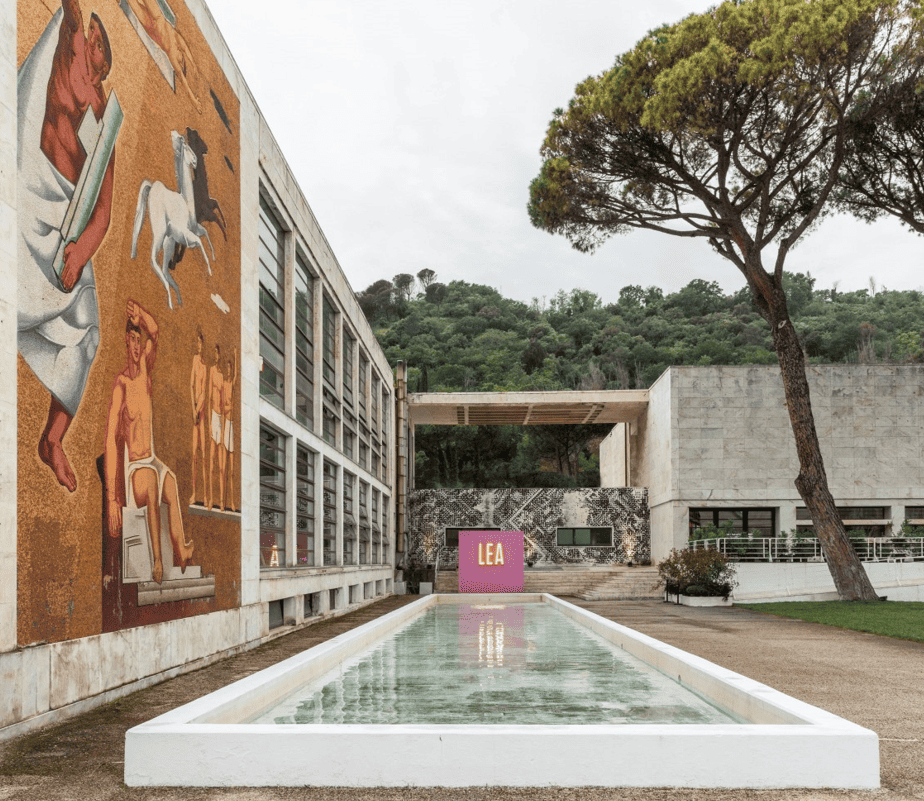
Starting from the Sala delle Armi (Fencing Academy – House of Arms), a rationalist building designed by Luigi Moretti between 1933 and 1937, which this year hosts for the first time LEA, the Sport and Health Hospitality format used for the Internazionali BNL d’Italia designed to welcome guests and sponsors of the tournament, the path of art and design begins, which continues in the Corporate Hospitality lounges around the Central Tennis Stadium.
Inside LEA at Sala delle Armi room, three suspended walls display the most recent cycle of paintings by Gianni Politi (Rome, 1986). The works were created using a collage technique from leftover canvas, cut into new shapes – symbols of his fascination with forms and tones that shape a symbolic relationship with the layering of time. The six artworks, 250x180cm, are mounted symmetrically, respecting the architecture of the room and recalling the lines of the ceiling designed by Moretti.
The project, in collaboration with MAXXI of Rome, seeks to underline the desire to elevate sport events by incorporating content of cultural value.
The works are on display between the restaurant, furnished with tables in solid wood by Studio F and Moroso’s Impossible Wood chairs, and the lounge area in which the Pebble Rubble sofas, designed by the Swedish designers Sofia Lagerkvist and Anna Lindgren of Front Design for Moroso, evoke a sensory experience that gives them a central role. An engaging and intriguing illusion that appeals to the viewer and piques their curiosity, altering their perception of time: “The collection is inspired by forms found in nature. 3D scanned rocks we saw on our many forest walks, composethese organic shapes together into furniture pieces.” (Front Design).
The coffee tables Miscellaneus and Marbelicious System by Millim Studio. Recovered marble sculpture fragments are assembled in organic shapes.
The term “system”, in the latter, indicates a series of elements, connected to each other, which interact and evolve as a single whole. The marble, an inert material and a classic archetype of static nature, becomes an expression of fluidity and movement in Marbelicious.
In the bar area, an installations of several Venus lamps by Serena Confalonieri for Servomuto amplify the heights of the room heights of the room through fluid shapes in metal and lycra inspired by the shapes of female body, symbol of eternal modernity.
The outdoor terrace features the Ivy sofas by Paola Navone and the Riviera chairs by Lucidi / Pevere for Emu. Ivy is a family of sculpture-furnishings with a linear and rigorous design, with sinuous and soft seats in matching with the large coffee table. Interpreter of a new concept for the outdoors living – that of an industrial-style steel living room – a characteristic feature of the collection is the metal mesh in sheet steel, which creates particular games of full and empty spaces.The Riviera chairs have a minimal and refined graphic sign; the all-welded structure, is made of tubular and bars with a rounded steel profile, in a sage green color.
Continuing toward the tennis stadium along Viale delle Olimpiadi, the visitor can join the maxxi poppyinstallation by STARTT studio di architettura e trasformazioni territoriali, that on the occasion of the 2023 Internazionali BNL d’Italia, these works are back to shine one more time transforming the famed Foro Italico complex with an evocative garden in bloom.
The work, winner of the first edition of YAP–Young Architects Program, the international award for young architectural talents, in the MAXXI architecture collection since 2011, finds a new temporary location becoming a luminous landmark for the city, thanks to the collaboration with Viabizzuno, who developed, engineered and manufactured them.
Upon reaching the Central Stadium, four more artists engage the dialogue with the architecture of four corporate rooms located behind the bleachers of the stands. TheForo Italico Club (FIC) roomhosts artworks by Andrea Sala (Como, 1976): Sala offered a series of drawings on small-scale canvas paper for the occasion, titled Frutta Bucata(2022) (“Pierced Fruit”). This series expresses the author’s interest in a tale that starts from the dawn of humanity and the history of art, an evolution of the still-life into sensual forms, and an outlet for a sculptural language. Here, it takes shape through two works: il trittico Piscine(2022) (“Swimming Pools”), in green pastels, water on travertine, that recalls the shapes of three iconic swimming pools, including the Salvador Dalí’s, and La biblioteca (sospensione) (2020) [“The Library (Suspension)”], that seeks to recall the distinct style of radiator-shaped shelving, a design halfway between domestic reality and fantasy.
On the walls close to the Central court, four small drawings on paper by Marta Mancini take up the sinuous lines of Andrea Sala’s works in a more intimate way, anticipating the structure of her paintings located in the next room.
The interior design at the FIC room, includes iconic pieces chosen in contrast with each other in terms of shapes and materials such as the Pacific sofa whose soft shapes are enhanced and defined by the total absence of edges and “couture” details, combined with the armchairs Ruff that synthesize in a simple geometry the encounter between curved and straight lines in architectural dialogue with the surrounding space as well as the Across tables in painted metal by Secondome.
The space is completed by the Pipe sofa by Sebastian Herkner, also for Moroso, whose structure is built with an 80 mm diameter powder-coated aluminum tube, surmounted by a cushion that evokes the idea of an inflatable module, and the Gogan armchairs whose name is inspired by the Japanese stones smoothed by time and water by Patricia Urquiola for Moroso.
Once you walk into the Montemario Sudroom, the path crosses with the graphic sign structure through a selection of paintings by Marta Mancini (Rome, 1981) who is showcasing her most recent series of paintings of small and large size, in which she delves into an archaic technique that is intended as an abstract and traditional form of expressionism.
Method also highlighted by the series of drawings exhibited in the FIC room, in which the need to bring the observer back to primordial signs, understood as a starting expressive degree, trace and complete the general exhibition itinerary that defines the vision of the previous rooms.
The interior leans on dark grey tones and small splashes of colour, adding a sense of life to a sophisticated room in which the eye is drawn to the Gogan sofa with its terrazzo fabric and the Getlucky armchairs by Patricia Urquiola for Moroso. The Glacials Pink Panther coffee table by Marco Pettinari, a single piece in plexiglass with pink shades, accompanies the tones of the works on the wall and enters in synchrony with the sofa.
At the far end is the Tabasettee, “the entwinement of form and poetry, between what is linear and what is elusive,” says the designer Alfredo Häberli.
In the Montemario Nord room, the graphic sign path continues with a series of paintings on rough linen by Alice Ronchi (Milan, 1989): the works entitled Universe (2022-2023), which play off the rigidity of the architecture of the room, are intended to guide the observer to reflect on the importance of family roots and the tradition of graphic signs as elements of evolution of the individual. Signs that make up basic symbols, like cave paintings, are contaminated by an alien symbology capable of linking the past to an unknown future.
The interior consists of faint colors between white and pastel shades that offer a backdrop to the works. The Bohemian sofa, a “liquid” reinterpretation of the classic padded couch, is matched with Cutout sculpture tables by Millim Studio, which work on the concept of subtracting shapes from a powder-coated metal sheet. The environment is completed by the Getlucky armchair with its inviting backrest wrapping up the design neatly like a small bow, by Patricia Urquiola for Moroso. In contrast, there is the Square settee and small armchair, designed by Jonathan Olivares for Moroso, created for the new Kvadrat showroom in NY.
The exhibition path ends in the Presidential Room, where the recent photographic research on the Foro Italico by Giovanna Silva (Milan, 1980) is displayed in two sizes, to offer a comprehensive understanding of the area and the historic sporting complex. Through its contemporary vision that covers modern elements, equipment, architectural adjustments, as well as daily life, it has formed a layer effect of multiple ages. The author’s objective is to put the visitor in a position to observe the beauty of an engineering complex designed in the 1920s and still considered one of the utmost avant-garde, despite the incessant rhythm of everyday life has marked one new fruition, more natural, less satisfying, but still part of the beauty of which the history of Rome and Italy is characterized.
For the interior, iconic sofas are used that were designed as innocent reflections which go through an accumulative process, unconscious pen strokes, doodles; it starts with a single line and ends with an elaborate and complex piece. It is merely the pretext for the embroidery. The sofa design takes its shape from a folded blanket. Doodleby Front for Moroso.
A series of plexiglas sculpted tables by Marco Pettinari completes the room as a result of a research on how to represent the idea of a primordial materia through artificial materials with modern lines.
A project by: Giorgio Galotti and Claudia Pignatale
Project Manager: Andrea Pivano
Masterplan LEA: Fabrizio Graziani
Light Design LEA: Massimo Pascucci
Official Suppliers: Emu, Moroso, Servomuto, Viabizzuno
Si ringrazia: Team Corporate Hospitality Internazionali BNL d’Italia, Galleria Lorcan O’Neill, Federica Schiavo Gallery, Materia
[ngg src=”galleries” ids=”23″ display=”basic_thumbnail” thumbnail_crop=”0″]